


HEDP Scale Inhibition: Why Calcium Hardness and pH Must Be Evaluated Together
A HEDP scale inhibitor should be evaluated against calcium hardness and pH together. A dosage that controls scale in one water may fail in another because the balance between dissolved calcium, carbonate, and phosphonate has changed. Under unfavorable conditions, calcium–HEDP precipitation can also introduce a deposit risk of its own.
The practical question is therefore broader than “How much HEDP is needed?” It is whether the treatment remains effective and sufficiently soluble across the water conditions the system will actually encounter, including concentration cycles, temperature changes, and temporary pH excursions.
Calcium hardness indicates loading; pH changes the chemical balance
Calcium hardness describes the calcium content of water, commonly reported as an equivalent concentration of calcium carbonate. It does not directly describe calcium carbonate saturation. Two waters with the same calcium hardness can have different scaling tendencies because their alkalinity, pH, temperature, and dissolved salt concentrations differ.
As pH rises, the carbonate system shifts toward a greater proportion of carbonate ions. When sufficient calcium is present, this generally increases the driving force for calcium carbonate precipitation. Alkalinity matters because it helps determine how much bicarbonate and carbonate are available; pH alone cannot supply that information.
HEDP, or 1-hydroxyethylidene-1,1-diphosphonic acid, also changes with pH. Its phosphonic acid groups progressively lose protons, altering its electrical charge and interactions with calcium and mineral surfaces. These changes affect both scale inhibition and calcium–phosphonate solubility.
A higher pH can increase the scaling challenge while also changing the behavior of the inhibitor. This is why a hardness limit or pH range taken in isolation is an incomplete basis for selection.
Scale inhibition does not require binding every calcium ion
HEDP can interfere with crystal nucleation and growth at concentrations below those needed to bind all the calcium in solution. This is commonly described as threshold inhibition. Its practical value comes from disrupting the formation of mineral deposits, rather than removing the entire calcium inventory.
A common dosing mistake is to treat HEDP exclusively as a stoichiometric chelant: more calcium is assumed to require a directly proportional increase in inhibitor. Calcium loading does matter, but required dosage also depends on supersaturation, temperature, residence time, competing ions, and the surfaces on which deposits can form.
Calcium binding and scale inhibition are related, but they are not interchangeable performance measurements. A strong calcium-binding result does not establish reliable deposit control under operating conditions.
When calcium–HEDP precipitation becomes a concern
HEDP can form soluble complexes with calcium. Under some combinations of calcium concentration, pH, inhibitor concentration, and water composition, calcium–phosphonate solids may also form. This means increasing dosage does not guarantee a proportional improvement in performance.
There is no single calcium hardness or pH cutoff that applies to every HEDP formulation and water matrix. Calcium tolerance depends on the conditions and the method used to assess it. A clear solution after a short mixing period provides different evidence from a heated test maintained for a representative residence time.
Local conditions around the injection point deserve attention. Poor mixing or contact between concentrated chemical streams can briefly create conditions very different from the bulk water. An inhibitor that performs acceptably after dilution may still produce haze or deposits where it first contacts calcium-rich water.
Cloudiness alone cannot identify the failure mechanism. Calcium carbonate, calcium–phosphonate solids, corrosion products, and other suspended matter may look similar. The cause determines whether the useful response is a dosage adjustment, improved mixing, pH control, or a different formulation.
Build the screening test around operating conditions
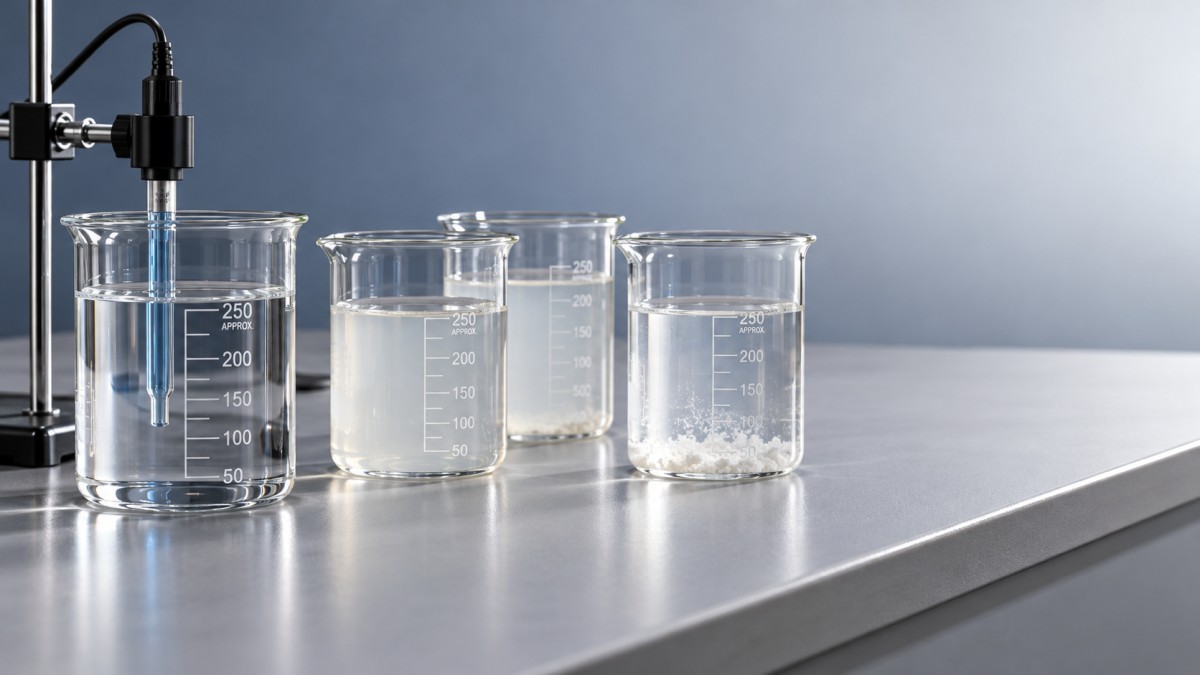
A useful laboratory program varies calcium hardness and pH independently while keeping the remaining conditions controlled. Testing one hardness at one pH establishes only one operating point. A small matrix covering normal operation and credible excursions provides a more useful picture of the treatment’s limits.
The water analysis should include calcium hardness, alkalinity, magnesium, sulfate, conductivity or dissolved solids, and relevant contaminants such as iron. For calcium carbonate control, a saturation calculation helps describe the challenge, although it does not predict inhibitor performance by itself.
Prepare test waters to represent the treated system. Cooling-water makeup can substantially understate the challenge in concentrated circulating water. For reverse osmosis applications, concentrate conditions and membrane compatibility need separate consideration; successful cooling-water screening does not establish suitability for membrane service.
- Use untreated controls at each condition. These show whether the water develops a measurable scaling challenge during the test.
- Compare equivalent active dosages. Record the active-content basis, product concentration, and neutralization form rather than comparing equal volumes of commercial liquids.
- Track pH during exposure. Heating, carbon dioxide exchange, and chemical addition can move pH away from its initial value.
- Match temperature and duration to the application. Short ambient tests can miss precipitation or deposition that develops during extended heated operation.
- Define sample handling. Filtration, cooling, preservation, and analysis timing can change the measured dissolved fraction.
HEDP acid can lower the pH of a test water. If that change is left uncontrolled, reduced carbonate precipitation may partly reflect acidification. Record the pH after dosing and compare treatments at the intended operating pH when assessing inhibition performance.
Read calcium retention alongside deposit evidence
Residual dissolved calcium is useful, but it should not be the only endpoint. A decrease may reflect calcium carbonate precipitation, calcium–phosphonate precipitation, or another calcium-containing solid. Conversely, high calcium retention does not establish that heat-transfer surfaces remain clean.
Combine dissolved-calcium results with turbidity, observations of wall deposits, and examination of recovered solids where necessary. Filtered and unfiltered phosphorus measurements can help investigate inhibitor partitioning, provided the analytical method distinguishes the phosphorus fractions relevant to the question. Total phosphorus alone cannot establish how much active HEDP remains.
Laboratory inhibition percentages also depend on the untreated control. If that control precipitates very little, a calculated percentage can become sensitive to small analytical differences. Report the underlying calcium measurements and test conditions alongside the calculated result.
Static screening is useful for comparing candidates. Where surface deposition is the operational concern, follow it with a test that represents flow and heated surfaces. Bulk-water stability and resistance to deposition are different endpoints.
Choose dosage and chemistry from the operating window
Select a dosage that performs consistently across the expected hardness–pH range, with allowance for realistic variation. If performance deteriorates sharply near normal operating conditions, simply increasing the feed rate may provide little useful margin. Evaluate pH adjustment, concentration control, feed-point mixing, or a complementary dispersant according to the identified failure mechanism.
An alternative phosphonate can also be included in comparative screening. Prio New Materials’ Partially neutralized sodium salt of bis hexamethylene triamine penta (methylene phosphonic acid) (BHMTPH·PN(Na2)) is a different chemistry from HEDP. Its stated calcium tolerance and carbonate- and sulfate-scale inhibition properties make it a candidate for assessment where calcium compatibility is limiting. It can also be evaluated with polycarboxylate dispersants. Those properties do not establish a direct replacement dosage; comparison should use declared active content and representative water conditions.
Before approving a HEDP scale inhibitor, define the calcium hardness, alkalinity, operating pH range, temperature, concentration factor, and expected residence time. Then establish whether the selected dose controls mineral deposition without introducing treatment-derived solids. That evidence supports a defensible operating window and gives plant personnel a clear basis for responding when water conditions change.

ONLINE CONSULTATION
If you have any questions, please contact us and we will contact you as soon as possible.