


Can pharmaceutical defoamer affect downstream filtration performance
A pharmaceutical defoamer can improve process stability while impairing downstream filtration if its insoluble fraction, emulsion carrier, or dosage is mismatched to the process. Foam collapse alone is therefore not sufficient evidence of suitability. The relevant question is whether the defoamer remains dispersed, is removed before the final filter, and avoids altering the filter cake, membrane surface, or product solution.
Problems often appear after an apparently successful addition. The vessel becomes easier to control, filling losses decrease, and mixing is more consistent, yet filtration differential pressure rises sooner than expected. This pattern frequently points to defoamer-derived hydrophobic material reaching the filtration stage. A small amount of oil-rich antifoam can spread across a large membrane area, reducing wetting and creating localized resistance even when the bulk liquid still looks clear.
How defoamer chemistry reaches the filter
Pharmaceutical defoamers are commonly formulated from silicone fluids, polyether systems, fatty alcohols, esters, hydrophobic silica, or combinations of these materials. Their filtration effect is governed by the full formulation rather than the active defoaming ingredient alone. A silicone-based product with a poorly matched emulsifier package can form droplets that deposit on hydrophobic membrane regions. A non-silicone product may be easier to rinse but can still interact with proteins, polymers, or suspended solids and alter cake permeability.
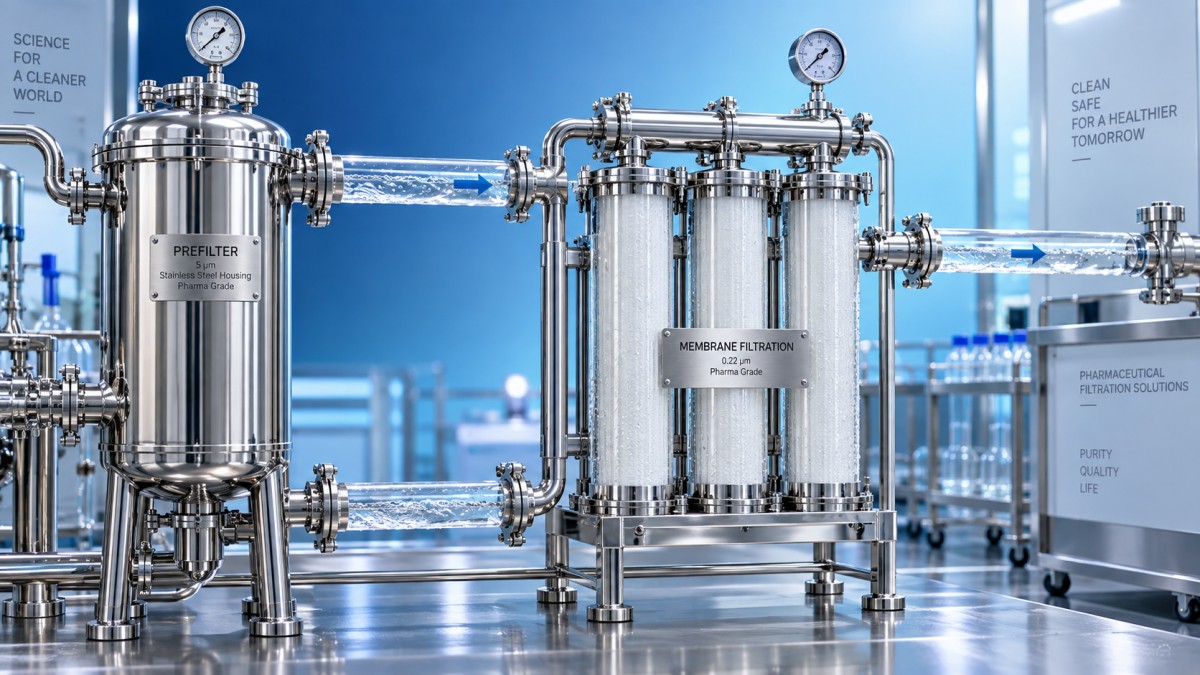
Particle-retaining filtration and membrane filtration respond differently. A depth filter may tolerate a dispersed defoamer initially, then blind when droplets collect on the filter aid or bind to fine solids. A sterilizing-grade membrane has a much smaller margin: residues can interfere with membrane wetting, reduce flux, or cause variable pressure behavior between batches. With tangential-flow filtration, defoamer can accumulate at the membrane interface, particularly when recirculation creates repeated exposure rather than a single pass.
Foam itself can also damage filtration performance, so eliminating it remains important. Entrained gas reduces effective filtration area, creates unstable pressure readings, and can promote pump cavitation or erratic flow. The objective is not to avoid defoamer categorically; it is to control foam with the least persistent amount of material compatible with the downstream separation train.
Dosage errors are often hidden by good foam control
Overdosing is a common source of misleading results because antifoams are highly active at low concentrations. When addition is based only on a visual foam endpoint, the process can receive substantially more material than is needed to prevent re-foaming. The excess does not improve filtration security. Instead, it increases the chance that free droplets or hydrophobic solids survive clarification and reach the final filter.
Addition location matters as much as total quantity. Introducing defoamer into a high-shear zone can break it into smaller droplets that remain suspended longer. This may produce rapid foam knockdown but makes subsequent removal more difficult. Adding it upstream of a suitable settling, centrifugation, adsorption, or depth-filtration step gives the process more opportunity to capture residual material. A late addition immediately before a final membrane filter creates the highest compatibility burden.
There is also a difference between preventing foam and breaking an established foam layer. Prevention normally requires less material. If repeated bolus additions are used to recover from severe foaming, each event can create a different residual burden. Recording addition timing, mixing conditions, and foam intensity alongside filtration pressure data is more informative than tracking total dosage alone.
Filter symptoms should be interpreted carefully
A rapid increase in differential pressure does not automatically prove that the defoamer is the cause. The same symptom can arise from insufficient prefiltration, precipitation caused by pH adjustment, microbial debris, incomplete dissolution, or an interaction between process ingredients. A useful comparison holds the batch composition, temperature, mixing sequence, and filtration train constant while changing only the defoamer condition.
Compatibility testing needs the real process sequence
A beaker test that measures foam collapse is useful for initial screening, but it cannot predict full filtration behavior. A representative study should include the actual process liquid, expected solids loading, temperature range, pH, shear exposure, hold time, and intended filter media. If the process contains protein, fermentation solids, polymeric excipients, or mineral particulates, the test should include them because these components can stabilize or transport defoamer droplets.
Screen candidate formulations at the lowest effective dose and observe more than foam height. Relevant observations include turbidity changes after holding, visible oiling-out, droplet separation, filter throughput, transmembrane pressure trend, and filtrate appearance. Where product quality testing is available, compare samples from the control and treated conditions for properties relevant to the product. A formulation that controls foam but changes filterability after a hold period should not be judged only on its immediate performance.
Filter media selection can change the result. Hydrophilic membranes are often less prone to initial wetting problems than hydrophobic media, but they are not immune to fouling. Depth media can retain antifoam efficiently, though its capacity depends on the material, pore structure, and solids burden. Filter aids may improve capture in one system while producing a denser cake in another. The selected defoamer and filter train should therefore be evaluated as a pair.
Process chemicals can complicate the diagnosis
In water-related processing, foaming, scale formation, corrosion products, and suspended solids may occur together. Their control chemistries should be assessed separately before assuming that a filtration problem comes from the defoamer. For example, phosphonate scale inhibitors such as Hexamethylene Diamine Tetra(Methylene Phosphonic Acid) (HDTMPA) are used to control mineral scale in water treatment and boiler-water applications; they serve a different function from a foam-control additive. If mineral precipitation is present, it can independently shorten filter life and obscure the effect of the defoamer.
Changes in water hardness, pH, ionic strength, or temperature can alter both foam behavior and dispersion stability. A defoamer that remains acceptable in a low-solids aqueous system may separate or associate with precipitates after a process adjustment. This is why troubleshooting should review water quality and chemical addition order together with the filtration record.
Practical controls that reduce filtration risk
- Use the minimum dose that prevents operationally significant foam, with a defined addition method rather than repeated visual corrections.
- Place the addition upstream of a removal step when the process permits it, leaving sufficient residence time for droplets or associated solids to be captured.
- Qualify the specific commercial formulation, including carriers and dispersants. Replacing one defoamer with another of the same broad chemical class can change filtration behavior.
- Trend pressure, flow, and throughput by batch and addition event. A stable average dose can conceal changes in injection point or mixing intensity.
- Investigate unexpected filter blinding with retained-material analysis where feasible, since visible foam control does not identify the source of foulant.
A pharmaceutical defoamer affects downstream filtration when its residual components persist in the process stream or change the behavior of retained solids. A low-residue formulation, controlled addition, and a filtration study that reflects actual operating conditions provide a defensible basis for balancing foam suppression with consistent filter performance.

ONLINE CONSULTATION
If you have any questions, please contact us and we will contact you as soon as possible.