


Can DTPMPA (CAS 15827-60-8) Be Used as a Chelating Agent in Peroxide Bleaching Systems?
Can DTPMPA (CAS 15827-60-8) Be Used as a Chelating Agent in Peroxide Bleaching Systems?
Yes—DTPMPA can be evaluated as a chelating agent in hydrogen peroxide bleaching systems, particularly where trace metals are contributing to peroxide loss. However, metal binding alone does not prove that a formulation will stabilize peroxide. Its suitability depends on the metals present, operating pH, temperature, water hardness and the rest of the bleaching recipe.
For textile processors and pulp mills, the practical question is whether DTPMPA helps achieve the required brightness while controlling peroxide consumption and protecting fiber quality. That requires testing under representative conditions, not simply selecting a chemical described as a strong chelator.
Why trace metals can disrupt an otherwise sound recipe
Iron, copper and manganese can enter bleaching systems through process water, raw fibers, recycled streams, chemical impurities or corroding equipment. Certain metal species catalyze hydrogen peroxide decomposition, diverting oxidant away from the intended bleaching reactions. The consequences may include uneven brightness, excessive chemical demand and localized fiber damage.
A low dissolved-metal result does not necessarily eliminate this risk. Metal-bearing deposits and particles can provide reactive surfaces, while metals associated with fibers may behave differently from those measured in incoming water. Investigations should therefore consider the substrate, deposits and process chemicals as well as the water supply.
Adding more peroxide can mask the problem without correcting it. If metal-catalyzed decomposition is significant, increasing the oxidant charge may increase losses rather than deliver a proportional improvement in whiteness.
What DTPMPA contributes—and what it does not guarantee
DTPMPA, or diethylenetriamine penta(methylene phosphonic acid), is an aminophosphonate identified by CAS 15827-60-8. Its multiple coordinating groups allow it to bind metal ions. This chemistry makes it a candidate for controlling metal activity in an appropriately formulated bleaching bath.
The important distinction is between complexing a metal and suppressing its catalytic activity. Some metal complexes remain capable of participating in peroxide decomposition. Performance depends on metal identity, oxidation state, ligand concentration and reaction conditions. A favorable complexation result is therefore useful screening information, but not a substitute for a peroxide stability test.
DTPMPA is also not automatically a replacement for every component of an established stabilizer package. Silicates, magnesium-containing additives and dispersants may serve different functions. Removing them while introducing a chelator can change bath behavior in ways that obscure the actual benefit of metal control.
The operating conditions that decide suitability
pH and temperature must be assessed together. Alkalinity supports peroxide bleaching, but also changes metal speciation and peroxide behavior. The acid form of DTPMPA contributes an acid load, so comparing treated and untreated baths without matching final pH can produce misleading results. Higher temperatures make realistic stability testing particularly important.
Hardness changes the chemical balance. Calcium and magnesium interact with phosphonates and can affect how much chelant remains available for other metals. Compatibility with hard water, alkaline conditions and existing additives needs confirmation. In some pulp systems, magnesium also contributes to peroxide protection; indiscriminate changes to metal management can disturb that balance.
Contamination sources determine the treatment strategy. A chelant may help with dispersed or dissolved metals, but it cannot repair corroding equipment or remove an established deposit by itself. Where feasible, controlling the contamination source is preferable to continually compensating through chemical addition.
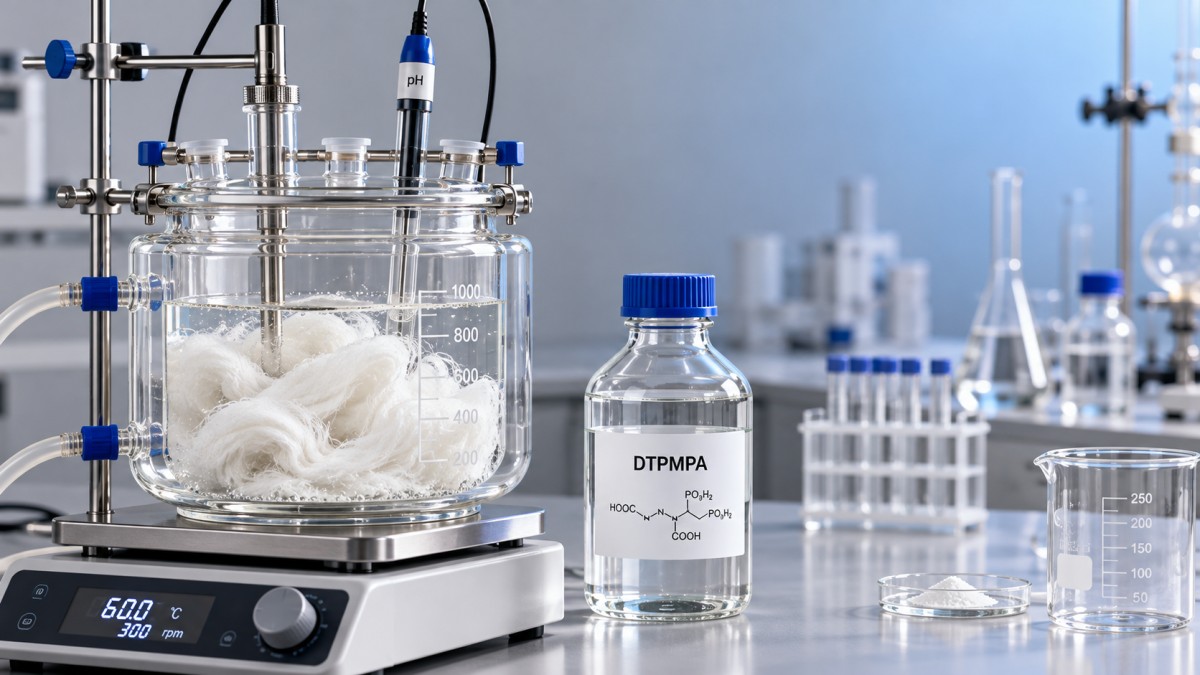
Addition sequence also matters. Pretreatment followed by washing can remove mobilized metals before bleaching; direct addition leaves the resulting complexes in the bleaching liquor. These are different approaches and should not be assumed to produce equivalent results. Never premix concentrated peroxide with a candidate additive without an approved compatibility and handling procedure.
A useful laboratory trial measures more than residual peroxide
Start with the current production recipe as the reference. Compare it with a controlled DTPMPA dose series, keeping substrate, peroxide charge, pH, temperature, mixing and treatment time consistent. Express dosage on an active-content basis rather than comparing commercial solutions by volume alone.
- Track residual peroxide over time, together with pH and temperature.
- Measure the relevant brightness or whiteness endpoint and its uniformity.
- Check fiber strength or another appropriate substrate-damage indicator.
- Inspect for precipitation, deposits, discoloration and unusual gas evolution.
- Repeat promising conditions with representative variations in water and metal loading.
High residual peroxide is not automatically a successful outcome: it may also mean insufficient bleaching reaction. Conversely, faster peroxide consumption is not proof of better bleaching. The decision should connect chemical consumption to finished-material quality.
There is no defensible universal dosage without the bath composition and contamination profile. Testing should identify the lowest effective dose and confirm that performance remains acceptable when production conditions fluctuate.
Keep bleaching chemistry separate from utility-water treatment
A mill may need both chelation in its bleaching process and deposit control in its cooling-water circuit, but these duties should not be confused. For example, Carboxylate-Sulfonate-Nonion Terpolymer PR-3100 is a scale inhibitor and dispersant for cooling-water applications, including systems containing iron, zinc and phosphate. Its stated functions include iron-oxide dispersion and stabilization of phosphate or phosphonate corrosion-inhibitor programs.
Those properties do not establish suitability for direct peroxide bleaching. A utility-water polymer should not be introduced into a bleaching recipe solely because it disperses iron oxide elsewhere in the plant. Oxidant compatibility, substrate effects and process acceptance require separate evidence.
What to confirm before a production trial
Confirm the supplied DTPMPA form, active content, impurity limits and batch documentation. Acid and salt forms can differ in neutralization demand and handling characteristics. Review phosphorus discharge requirements and potential effects of metal complexation on downstream wastewater treatment against the site's actual permit and treatment process.
Prio New Materials combines organophosphorus chelating-agent supply with formulation development, laboratory testing and water-condition technical support. For an application review, useful starting information includes the complete bleaching recipe, water analysis, substrate type, temperature profile and current peroxide-loss pattern. These details support a meaningful evaluation rather than a generic product recommendation.
DTPMPA is therefore a credible candidate—not an automatic solution. Proceed when controlled trials demonstrate better peroxide utilization at the required product quality, without unacceptable deposits, fiber damage or downstream treatment effects.

ONLINE CONSULTATION
If you have any questions, please contact us and we will contact you as soon as possible.