


A lower price per tonne does not always mean a better HEDP scale inhibitor deal. Compare the cost of active HEDP delivered against your specification.
For procurement teams, fair comparison starts by converting each offer to a cost per unit of active HEDP, rather than comparing supplied solution weight alone.
Concentration, assay basis, impurity limits, freight and delivery terms all affect purchasing cost. Quality documentation and supply reliability determine whether the apparent saving survives actual delivery.
Start with three questions: are quotations chemically comparable, what does each delivered kilogram of active HEDP cost, and can the supplier consistently meet your requirements?
What Are You Actually Buying When a Quote Says “60% HEDP”?
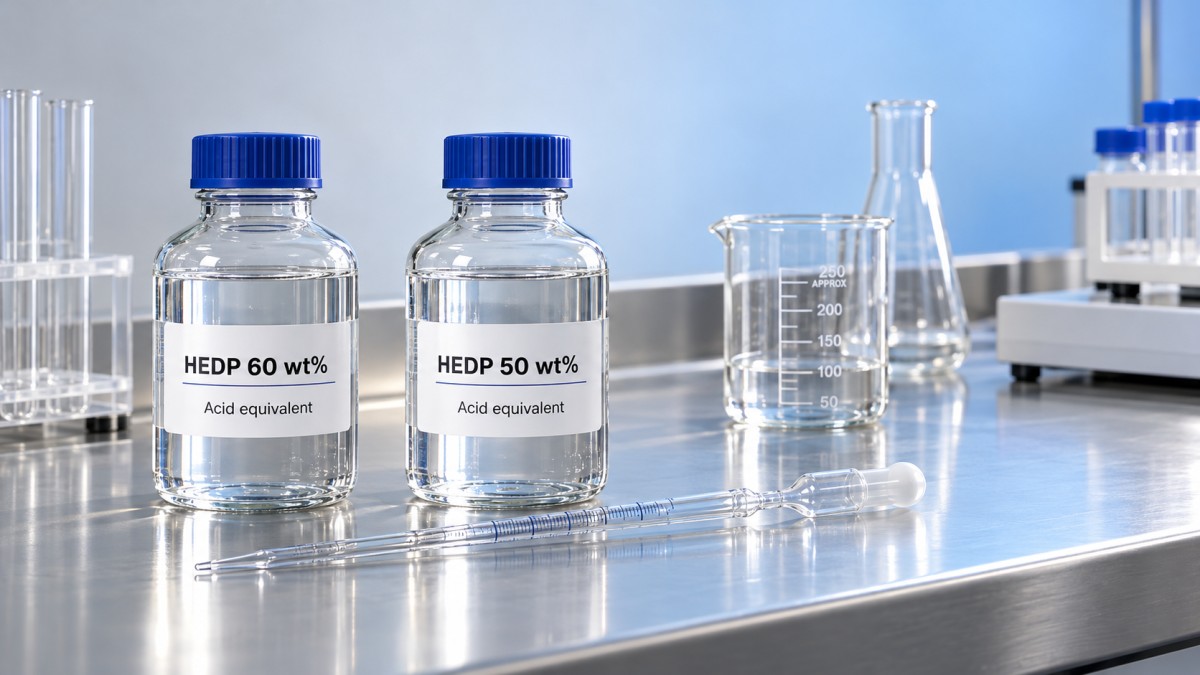
HEDP, or 1-hydroxyethylidene-1,1-diphosphonic acid, is an organophosphorus scale inhibitor and chelating agent. Commercial offers must identify the chemical form and the basis used to express concentration.
A percentage without an assay definition is insufficient. Ask whether the quoted value represents HEDP acid equivalent, a specified salt, total solids, or another measurement.
For liquid quotations, confirm that concentration is expressed as a mass percentage. Volume-based information requires density and temperature references before it supports a reliable comparison.
Do not treat total phosphorus, total solids, and active HEDP as interchangeable. These measurements answer different questions and cannot independently establish equivalent HEDP content.
Request the specification, analytical method, and a recent representative certificate of analysis. Confirm that the quoted concentration is a guaranteed minimum or an indicative value.
Where a specification permits an assay range, calculate purchasing exposure using the contractual minimum. Treat higher typical results as supporting information unless they are guaranteed.
How Do You Calculate Cost per Tonne of Active HEDP?
The basic calculation is straightforward: divide the price per tonne of supplied product by its active mass fraction, expressed on the agreed chemical basis.
Apply the same calculation to delivered cost when comparing suppliers. Include all relevant purchasing charges within an identical delivery boundary and use one consistent currency.
The hypothetical quotations below show why concentration matters. Prices illustrate purchasing arithmetic only; they do not represent current market offers or recommended commercial pricing.
Supplier B appears cheaper per tonne of solution, but Supplier A costs less per tonne of active HEDP under these assumptions, including the stated delivery charges.
To purchase six tonnes of active HEDP, you need ten tonnes of the 60% solution or twelve tonnes of the 50% solution, before handling losses.
That additional solution volume can increase freight, storage demand, packaging movements, and unloading work. Include these costs when they materially affect your purchasing decision.
Which Extra Costs Can Reverse the Quote Ranking?
Choose a common destination and delivery boundary before comparing quotations. An EXW offer and a CIF offer contain different cost components and risk allocations.
Build a consistent delivered-cost worksheet covering freight, insurance, destination handling, customs clearance, applicable duties, and inland transport. Avoid adding charges already included in the quotation.
Treat recoverable taxes consistently with your finance policy. Also record payment timing, currency exposure, quote validity, minimum order quantity, and any container or packaging deposits.
Use net chemical weight rather than gross shipping weight. For volume quotations, convert using the specified product density at the stated temperature before calculating active content.
Compare packaging against your unloading equipment and consumption rate. A lower bulk price may lose its advantage if it creates excessive inventory or handling costs.
What Quality Evidence Should Procurement Require?
A useful certificate of analysis identifies the batch, measured results, specification limits, and relevant methods. A generic specification sheet alone does not demonstrate batch conformity.
Agree acceptance limits for active content and application-relevant impurities. Depending on your process, these may include chloride, iron, and residual phosphorus species such as phosphorous acid.
Appearance, density, and pH can support receiving checks, but they do not replace an active-content assay. Define pH dilution conditions and density measurement temperature.
For unfamiliar suppliers, arrange representative sample testing before a substantial order. Where results differ, check sampling procedures and analytical methods before concluding that material is nonconforming.
Put the acceptance process into the purchase agreement: sampling responsibility, retained samples, testing deadlines, dispute laboratory, and remedies for material that fails the agreed specification.
Obtain the current safety data sheet and confirm storage, handling, and documentation requirements. Verify certifications against their scope rather than accepting an unexplained certificate logo.
When Does Application Performance Matter More Than Active Price?
Active-content normalization works best when comparing equivalent HEDP grades for the same duty. It does not prove that different inhibitors deliver equal performance per kilogram.
For an approved HEDP formulation, compare active cost first, then verify compatibility. For a new application, evaluate treatment cost at a demonstrated effective dosage.
Relevant conditions include temperature, pH, alkalinity, calcium concentration, scale species, and interactions with other treatment chemicals. Laboratory screening should reflect the intended operating conditions.
For reverse osmosis applications, confirm membrane compatibility and performance at the proposed recovery. Calcium sulfate control should be assessed against the actual feedwater and concentrate chemistry.
Where the duty warrants evaluating another phosphonate, Prio New Materials offers Potassium Salt of HexaMethyleneDiamineTetra (MethylenePhosphonic Acid) (HDTMPA·K6) for application-specific technical assessment.
This highly soluble product is positioned for calcium sulfate scale control, including boiler water treatment and RO applications, with particular relevance to high-alkalinity, high-pH conditions.
Its specification lists 21.2–24.6% active content as HDTMPA, versus 31.0–36.0% as the potassium salt. These values illustrate why the reporting basis must be explicit.
Those percentages cannot be directly compared with HEDP assay values to establish treatment value. Selection requires chemistry-specific assessment, compatibility checks, and suitable performance testing.
What Should Your Final RFQ and Purchase Decision Include?
Send every supplier the same RFQ: chemical identity, assay basis, guaranteed active minimum, impurity limits, analytical methods, required quantity, packaging, destination, and requested delivery schedule.
Ask suppliers to separate product price from logistics charges and state delivery terms precisely. Request batch documentation, production lead time, and procedures for handling quality claims.
Assess supply reliability through evidence: batch traceability, historical consistency, capacity for your order size, inventory arrangements, and responsiveness when technical or delivery problems arise.
Prio New Materials supports bulk chemical supply, customized formulations, and water-condition technical services. Buyers can request specifications, sample evaluation, and quotations aligned with their operating requirements.
Select the lowest evaluated cost among suppliers that meet your technical and delivery requirements. Document the assumptions so colleagues can reproduce and review the comparison.
A sound HEDP scale inhibitor purchase combines a verified assay basis, normalized delivered cost, enforceable quality requirements, and dependable supply. The cheapest solution tonne is only the starting point.